
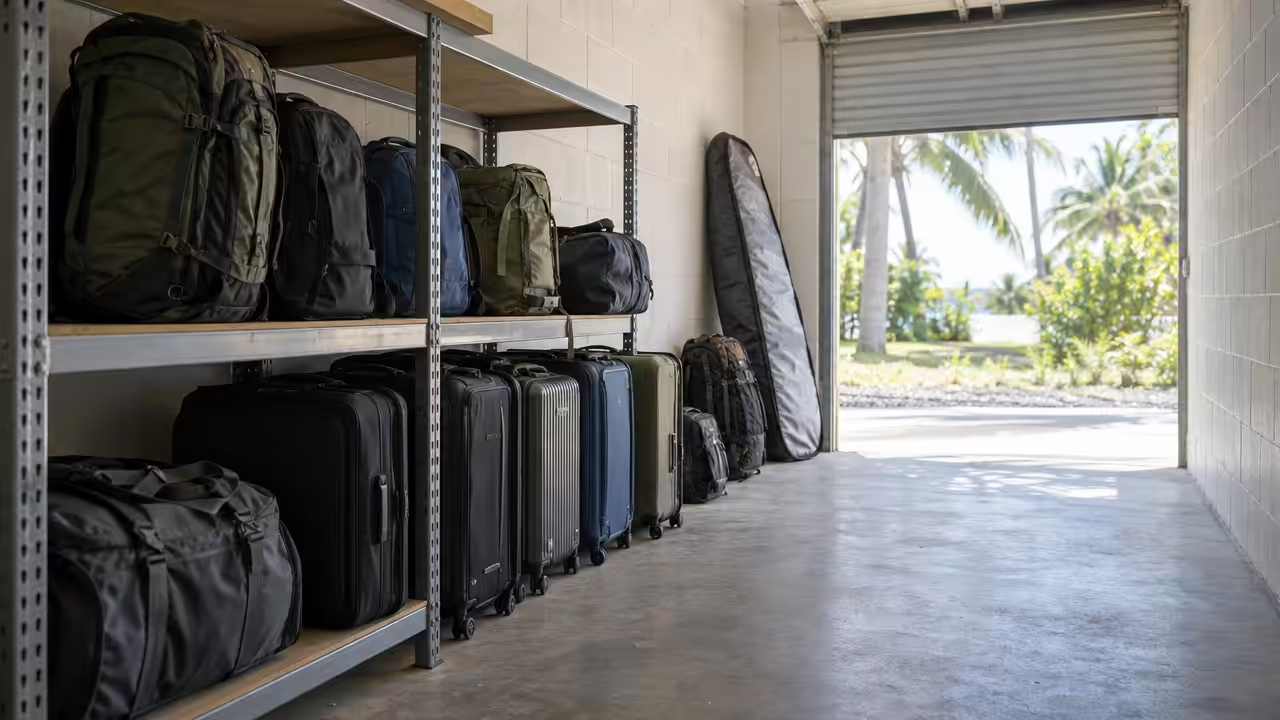
Ask about luggage storage on Koh Samui and you’ll get four different answers, because the people asking are in four different situations. Someone with a six-hour gap before a Bangkok flight needs something completely unlike what a seasonal resident needs when they’re heading back to Europe for four months with two suitcases, a bicycle, and a box of kitchen things they’d rather not buy twice.
The word “luggage” hides that difference, and it’s the difference that matters. Get it wrong for a long absence and the cost doesn’t show up until you’re back on the island, unzipping a bag and finding out what the last few months did to it.
Hours or a Day: Don’t Overthink It
If you’re between check-out and a flight, or off to Ang Thong for the day before a night boat, your hotel or guesthouse is almost certainly the right answer. Most will hold bags through the day, plenty will hold them a night or two after you’ve checked out, and it usually costs nothing.
Please don’t ring a storage company for that. A storage facility is built around rooms and monthly terms, not a counter where you hand over a rucksack and take a numbered ticket. You’d be crossing the island to solve something the front desk sorts out in thirty seconds.
A Few Weeks: The Awkward Middle
Visa runs, a fortnight in Vietnam, a month at home for a wedding. This is the range where people improvise, and improvising is where things go wrong.
The usual improvisations are a friend’s spare room, a landlord who says they’ll keep an eye on it, or a hotel that agrees to stash three bags in a back room “for a couple of weeks”. None of those are bad people. They’re just not storage. A spare room on Samui is a room with the windows shut, and a hotel back room is wherever the staff can find space, which might be next to the laundry or under a leaking air-con line.
If it’s genuinely two or three weeks and the bags contain clothes and shoes, you’ll probably get away with it. If it’s a month or more, or if there’s anything electronic, leather, wooden or paper in there, stop improvising.
What the Climate Does to a Bag Left Standing
Here’s the bit that catches people out. Bags aren’t damaged on Samui by anything dramatic. They’re damaged by sitting still.
Warm, still, humid air against fabric for weeks is what produces the smell you can’t get out of a jacket, the white bloom on leather boots, the camera lens with something growing inside it, and the corroded contacts on a charger. None of that needs a flood or a break-in. It just needs time and no moving air.
Pests are the second half of it. A soft bag sitting on a tiled floor in a quiet room is an invitation, and the things people leave in luggage without thinking, a half packet of biscuits, a sachet of coffee, a bar of soap, are exactly what draws them in.
Where a Storage Room Actually Wins
Past about a month, the calculation changes, and this is the part worth being blunt about. A hotel luggage room is the wrong answer for a long absence no matter how generously it was offered, because nothing in it is designed for the problem.
Every room at Samui Storage is fitted with a moving fan and a ventilation fan, and every room is pest-controlled monthly. That’s the whole point for a bag that’s going to sit. Air keeps moving across it rather than settling, and something is actively being done about the insects rather than hoped about them. The rooms are dry, secure and clean, and they’re yours, which means nobody is shifting your bags to make space for a delivery while you’re in another country.
Terms are easy-in, easy-out, so a room can be rented for as little or as long as you need. In practice that means you’re not signing anything that outlives your trip. And if what you’re leaving behind has crept past luggage into furniture and boxes, which happens to nearly everyone after a year or two on the island, it’s the same conversation and the same facility. The guide to working out what size room you actually need is the place to start on that.
The Detail Nobody Plans For
Office hours. It sounds trivial and it isn’t, because storage isn’t a locker bank you can reach at 2am on the way to a 6am flight.
Samui Storage is open Monday to Friday from 9:15am to 4pm, and Saturday from 9:15am until 1pm, closed Sunday. If your flight is early on a Sunday, your bags need to be dropped off on the Saturday morning, and the same applies coming back. Plan the drop-off as a separate errand a day or two before you travel, not as something you’ll squeeze in on the way to the airport. Everyone who has tried the second version has a story about it.
Packing a Bag That’s Going to Sit
A bag packed for a flight and a bag packed to be left for four months are not the same bag, and repacking takes twenty minutes.
Everything goes in clean and completely dry, which is the step people skip. Shoes worn on a beach that morning, a damp swimming costume, a shirt that went in slightly humid from the line: all of those keep working on the rest of the bag the entire time you’re away. Food comes out, all of it, including the things that don’t feel like food. Batteries come out of anything that takes them. Don’t seal clothes inside plastic bags thinking you’re protecting them, because sealed plastic traps whatever moisture was already there.
Get the bag off the floor if you can, leave a gap around it rather than wedging it against a wall, and write on a luggage tag what’s inside, because four months is long enough to forget. The full run-through on preparing things before they go into storage covers this properly, and most of it needs doing a day ahead rather than on the morning itself.
Getting It Sorted Before You Fly
Work out the length of the absence first, then decide. Under a day, use the hotel. Two or three weeks with soft goods only, improvise if you must. A month or more, or anything with electronics, leather, documents or instruments in it, put it somewhere with moving air and monthly pest control and stop thinking about it.
If that’s you, describe what you’re leaving and how long you’ll be gone, and you’ll get a straight answer rather than a sales pitch. Samui Storage is a British family-owned business that’s been doing this on the island since 2009, and small, valuable things can go in a security cage rather than a room if that suits the load better. If you’re leaving for good rather than for a season, mention that too, because the removals service handles domestic, regional and international moves and it’s simpler to plan the storing and the shipping in one conversation. There’s more on the company and who runs it if you’d rather know who’s holding your things first.
Otherwise, send the details through the contact page or a WhatsApp message before you book your flight, not after. It’s a five-minute job that stops your luggage becoming a problem you inherit on the way back in.


